.png&w=1080&q=75)
 Photo: Peter K Burian, CC BY-SA 4.0
Getting Around
How Far Are the Cotswolds from London? How to Get There by Train or Car
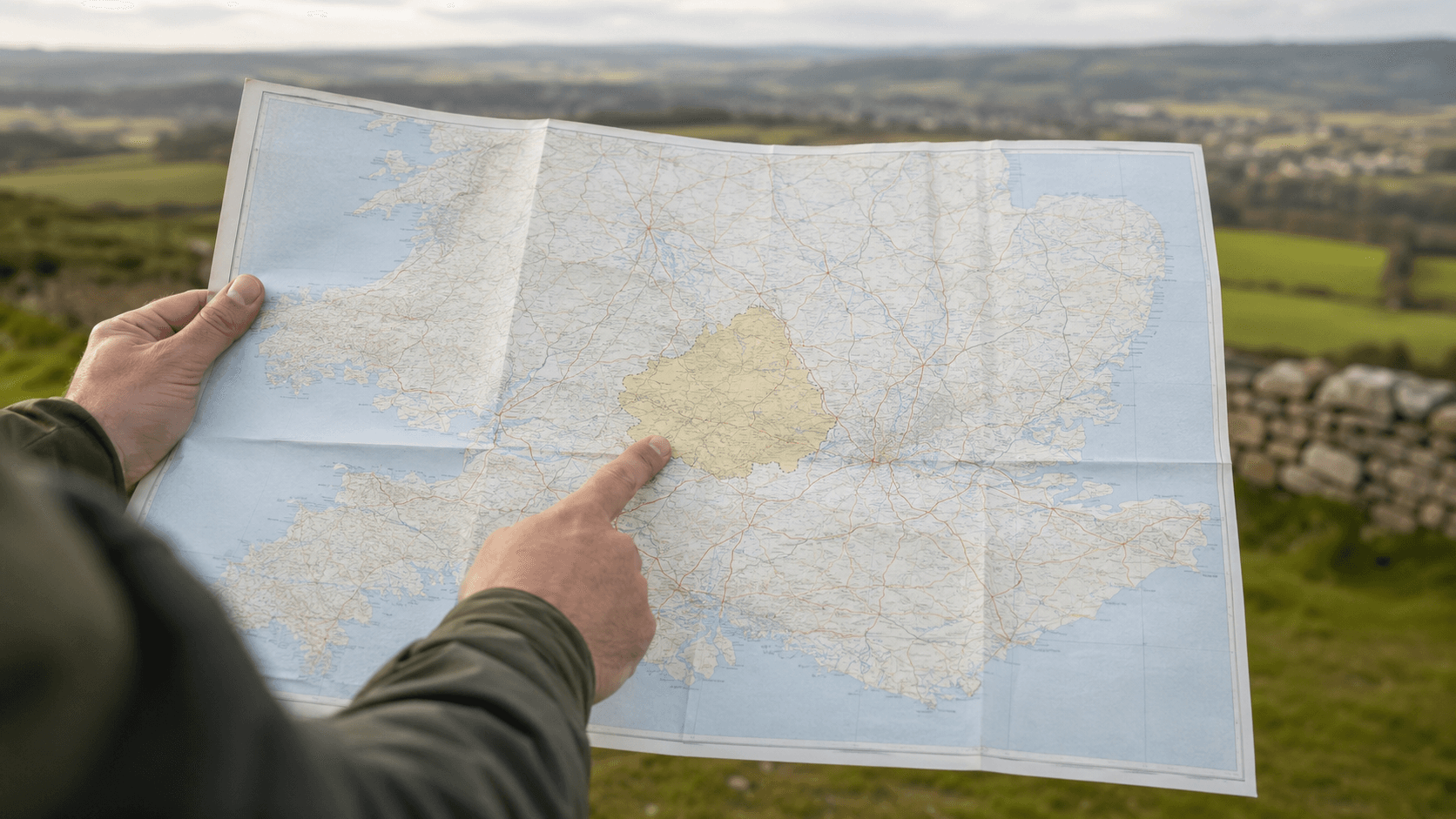
The Cotswolds are roughly 75 to 100 miles from central London, depending on which part of the region you are visiting. There is no single London-to-Cotswolds distance because the Cotswolds covers around 790 square miles and stretches for roughly 90 miles from north to south.
For most visitors, the more useful question is how long does it take to get from London to the Cotswolds?
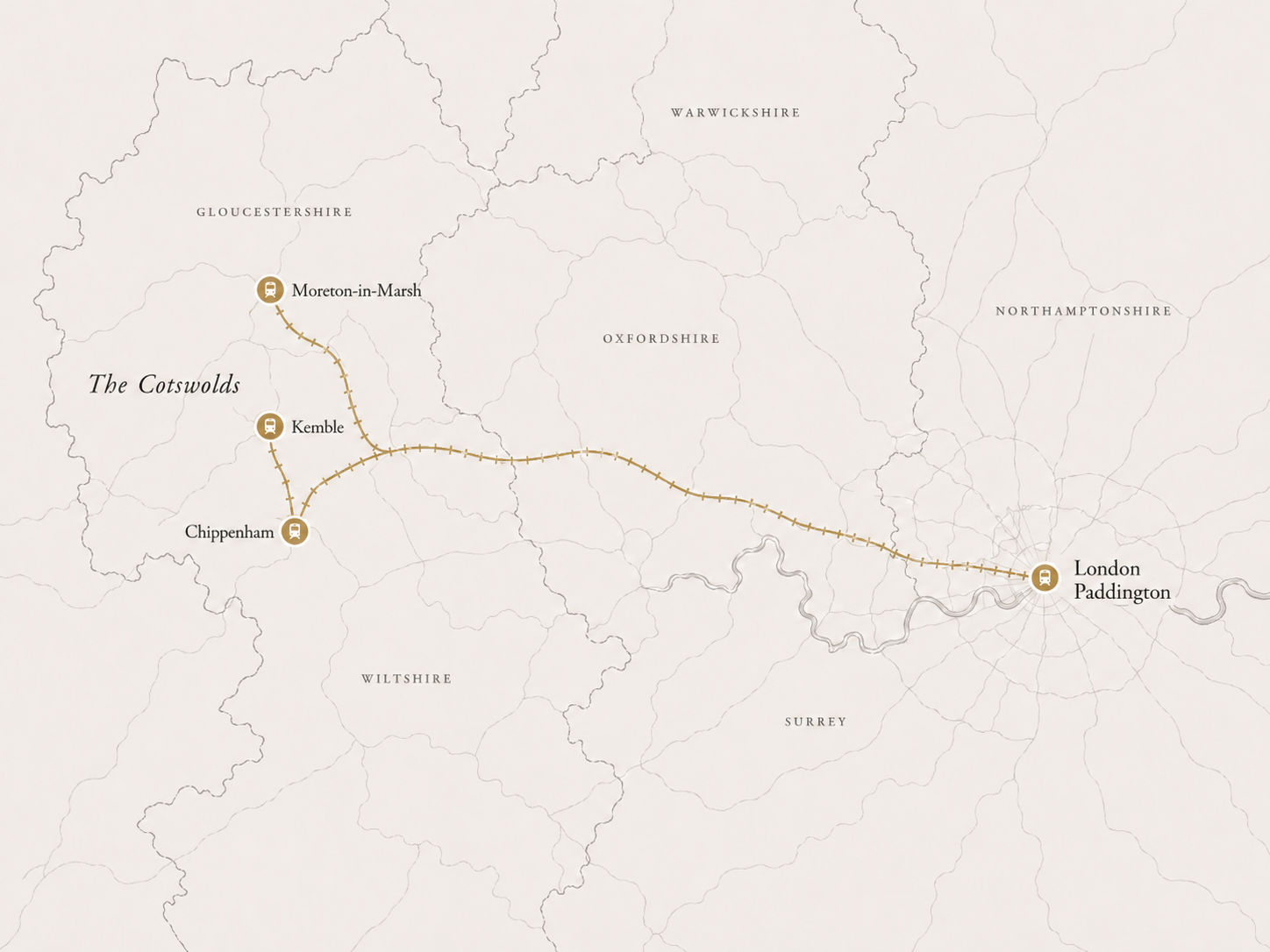
Direct trains from London Paddington can reach Kemble in as little as around 1 hour 6 minutes and Moreton-in-Marsh in around 1 hour 24 minutes on the fastest services. Both are useful Cotswold rail gateways, but they serve different parts of the region.
Driving gives you more freedom once you arrive, but journey times depend heavily on where you start in London, traffic and your final destination. As a rough planning rule, allow around two hours or more each way for many popular parts of the Cotswolds rather than treating the region as a quick hop outside the capital. This is an approximate planning figure, not a fixed journey time.
The simplest answer: the Cotswolds are close enough to London for a day trip, but the region is too large to treat as one destination. Choose the part you want to visit first, then decide whether train, car or coach makes the most sense.
London to the Cotswolds at a glance
| Question | Answer |
|---|---|
| How far are the Cotswolds from London? | Roughly 75–100 miles to many popular parts of the region, depending on your destination |
| How long is the train from London to the Cotswolds? | Fastest direct services can reach Kemble in around 1 hour 6 minutes and Moreton-in-Marsh in around 1 hour 24 minutes |
| Which London station serves the Cotswolds? | London Paddington is the main departure point for direct GWR services |
| Can you drive from London to the Cotswolds? | Yes. Driving is often the most flexible option for visiting several rural villages |
| Can you visit the Cotswolds without a car? | Yes, but your choice of destinations matters and onward transport needs more planning |
| Can you do a Cotswolds day trip from London? | Yes, but one compact part of the region is more realistic than trying to cross the whole Cotswolds |
Great Western Railway operates services from London Paddington along routes serving stations in and around the Cotswolds, including Moreton-in-Marsh in the north and Kemble, Stroud and other stations on the route towards Cheltenham.
How far is the Cotswolds from London?
There is no single mileage figure for the Cotswolds.
This is the biggest problem with answering the question using one number.
The Cotswolds is a large protected landscape rather than a town. Travelling from London to an eastern or northern Cotswold gateway is a different journey from travelling to the southern Cotswolds near Castle Combe and Bath. Current London travel guides commonly place popular Cotswold destinations around 80 to 100 miles from the capital, while the actual distance depends on the place chosen.
For example, the rail distance from London Paddington to Moreton-in-Marsh is approximately 73 miles, while the rail journey to Kemble covers around 80 miles.
That does not mean Kemble is necessarily "further into" the Cotswolds. The two stations simply sit in different parts of a long region.
The useful first step is therefore to decide where in the Cotswolds you actually want to go.
How to get to the Cotswolds from London
There are three main options: train, car or coach.
The best choice depends less on the journey out of London and more on what you intend to do after arriving.
| Transport | Best for | Main drawback |
|---|---|---|
| Train | Reaching one area quickly without driving from London | Most famous rural villages do not have railway stations |
| Car | Visiting several villages or places with limited public transport | London traffic, rural driving and parking |
| Coach | Lower-cost travel to larger towns such as Cirencester or Cheltenham | Slower and less useful for moving between villages |
| Organised tour | Seeing several locations in one day without planning transport | Fixed route and less independence |
The key distinction is this:
Getting to the Cotswolds by public transport is relatively straightforward. Getting around the rural Cotswolds without a car takes more planning.
GWR trains serve stations across different parts of the region, while local buses, taxis and some tours provide onward connections. The official tourism site also notes that rail access is useful for key towns and stations, but travel deeper into the countryside often relies on onward transport.
London to the Cotswolds by train
For many visitors, the train is the quickest and simplest way to leave central London.
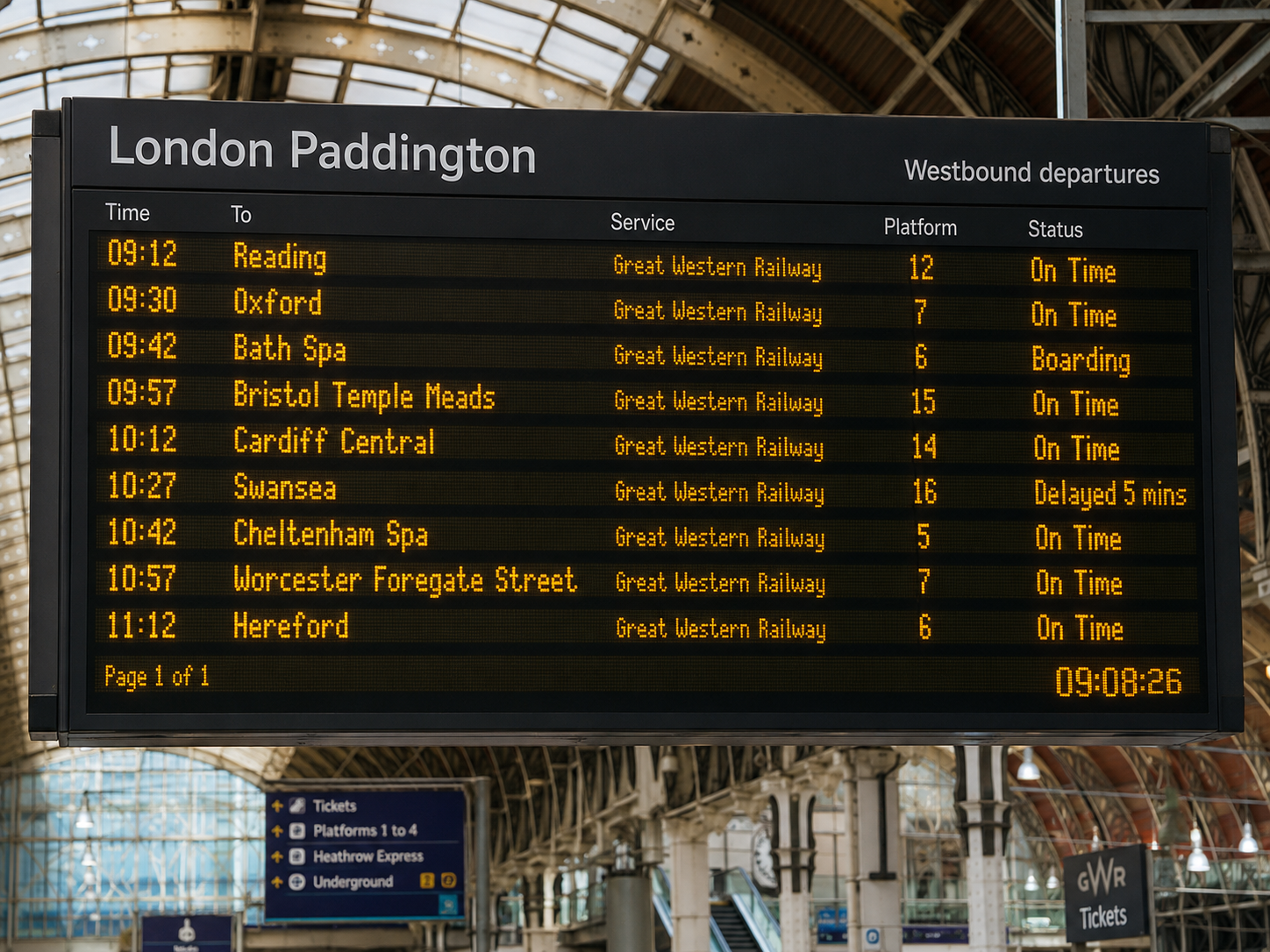
Direct services operate from London Paddington, but there is no station simply called "the Cotswolds". You need to choose a station based on the area you want to explore.
Moreton-in-Marsh for the northern Cotswolds
Moreton-in-Marsh is one of the most useful rail gateways for the northern Cotswolds.
The fastest trains from London Paddington can reach Moreton-in-Marsh in approximately 1 hour 24 minutes, with a rail distance of around 73 miles. Direct services operate on the route.
Moreton-in-Marsh itself is a Cotswold market town, so unlike some gateway stations, you arrive directly in a place you can explore rather than at an isolated transport interchange.
It is also a useful starting point for the wider northern Cotswolds, although visiting surrounding villages still requires a bus, taxi, tour or other onward transport. The official Cotswolds tourism site describes Moreton-in-Marsh as having direct London rail access and connections to other towns and villages.
Best suited to: the northern Cotswolds and visitors who want to avoid driving out of London.
Indicative route only. See the fastest direct train times stated above. Google's transit routing may not always reflect the exact GWR service.
Kemble for Cirencester and the central Cotswolds
Kemble is another important rail gateway.
The fastest trains from London Paddington can reach Kemble in approximately 1 hour 6 minutes, with a rail distance of around 80 miles. Direct services are available.
Kemble is particularly useful for reaching Cirencester. The official tourism site identifies Kemble as Cirencester's closest railway station, with the onward bus journey taking approximately 17 minutes.
It can also be used as a starting point for places deeper in the central Cotswolds, but these require further travel. For example, Bibury Trout Farm lists Kemble as its nearest railway station, with the route continuing via Cirencester and the B4425.
Best suited to: Cirencester and parts of the central Cotswolds.
Indicative route only. See the fastest direct train times stated above. Google's transit routing may not always reflect the exact GWR service.
Chippenham for Castle Combe and the southern Cotswolds
For Castle Combe, travelling to Moreton-in-Marsh would take you to the wrong end of the Cotswolds.
Chippenham, on the main rail line from London Paddington, is the more useful station. Visit Wiltshire identifies Chippenham as the nearest railway station for Castle Combe, with the final journey continuing by road.
This is a good example of why there is no universal "best train station for the Cotswolds". The right route depends entirely on the places you intend to visit.
Best suited to: Castle Combe and parts of the southern Cotswolds.
Indicative route only. See the fastest direct train times stated above. Google's transit routing may not always reflect the exact GWR service.
Which Cotswolds train station should you use from London?
| You want to visit | Useful rail gateway | What to know |
|---|---|---|
| Northern Cotswolds | Moreton-in-Marsh | Direct from Paddington and useful for onward travel |
| Moreton-in-Marsh itself | Moreton-in-Marsh | You arrive directly in the town |
| Cirencester | Kemble | Requires a short onward bus or taxi journey |
| Bibury | Kemble | Train only completes the first part of the journey |
| Castle Combe | Chippenham | Requires onward road transport |
| Western Cotswolds | Stroud or Cheltenham area | Choice depends on the exact destination |
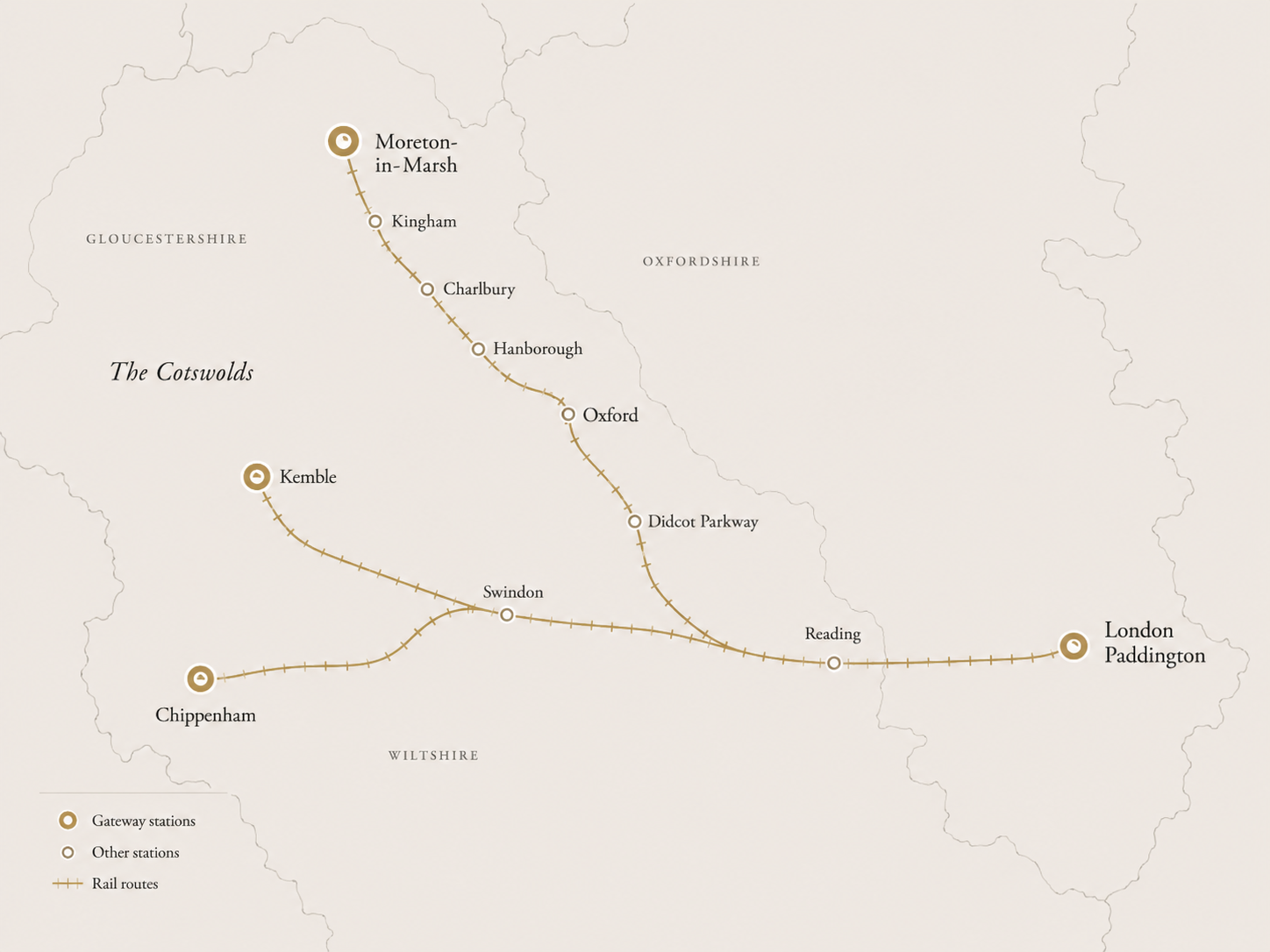
These are practical gateways rather than a definitive list. GWR services run along two principal rail corridors serving stations in and around different parts of the Cotswolds.
Always check the current timetable for your exact travel date. GWR states that its timetables are normally updated twice a year, and engineering works can alter individual journeys.
London to the Cotswolds by car
Driving is usually the most flexible option if the purpose of your trip is to visit several rural villages.
You can travel directly to your chosen destination rather than arranging a second journey from a railway station. This becomes increasingly useful when combining smaller villages, countryside locations or attractions outside the main public transport routes.
The trade-off is that the journey begins in London.
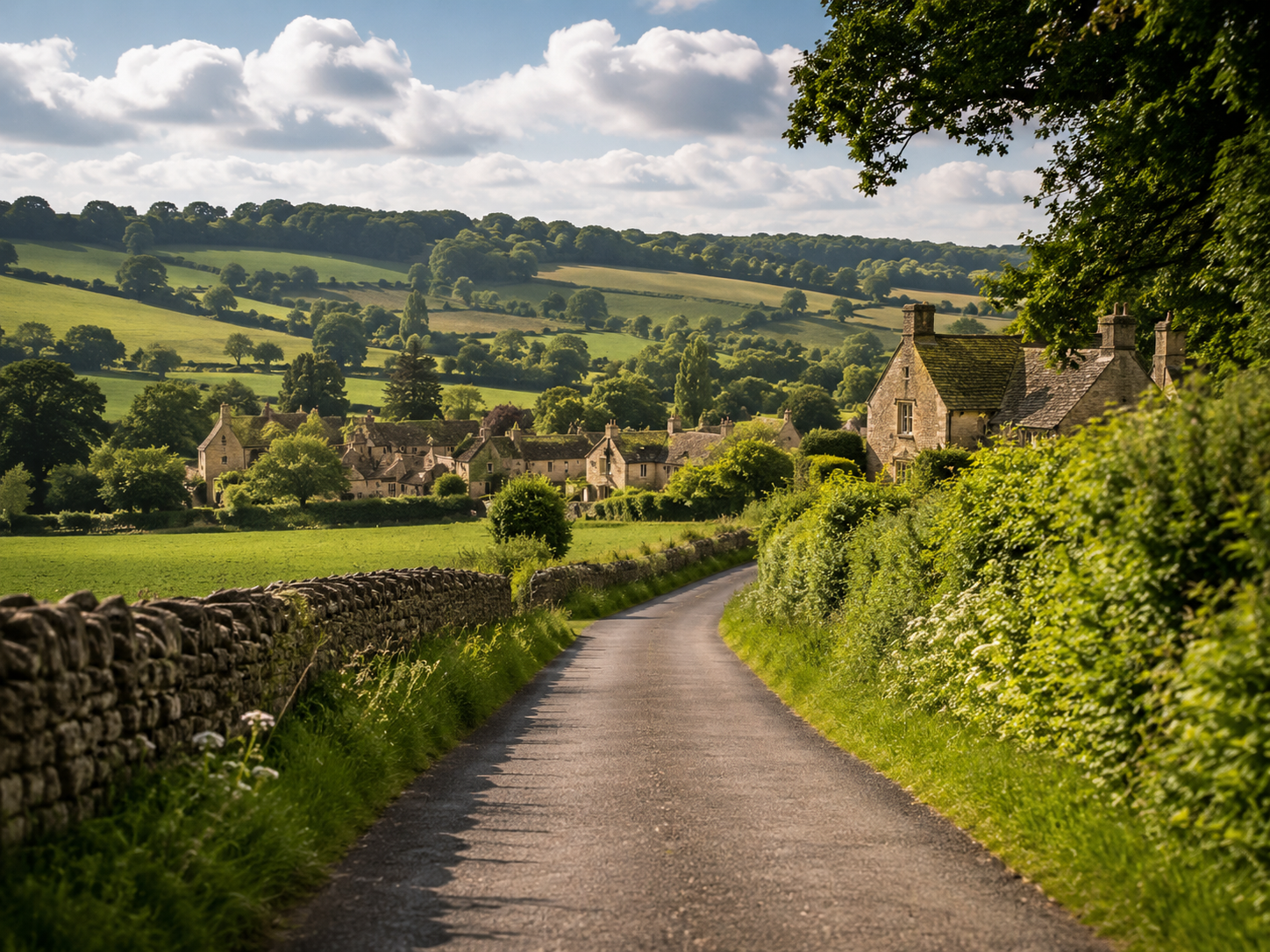
Traffic can make a substantial difference to travel time, particularly when leaving or returning to the capital. The final section of the journey may also involve narrower rural roads, and parking arrangements vary significantly between Cotswold villages.
For that reason, it is better to plan your route to a specific village or car park rather than asking a navigation app for directions simply to "the Cotswolds".
Which road route should you take?
The route depends on the part of the Cotswolds you are visiting.
Broadly, journeys towards the northern and eastern Cotswolds commonly approach via the Oxford side of the region, while the M4 corridor is more useful for parts of the central and southern Cotswolds. A route to Cirencester, for example, is very different from a route to Moreton-in-Marsh or Castle Combe.
The important thing is to choose the destination before choosing the route.
Can you travel from London to the Cotswolds by coach?
Yes, although coach travel is generally more useful for reaching larger towns than for exploring rural villages.
National Express operates London services to destinations including Cirencester and Cheltenham. Current published information shows direct coach options from London Victoria, although journey times and timetables should always be checked for your travel date.
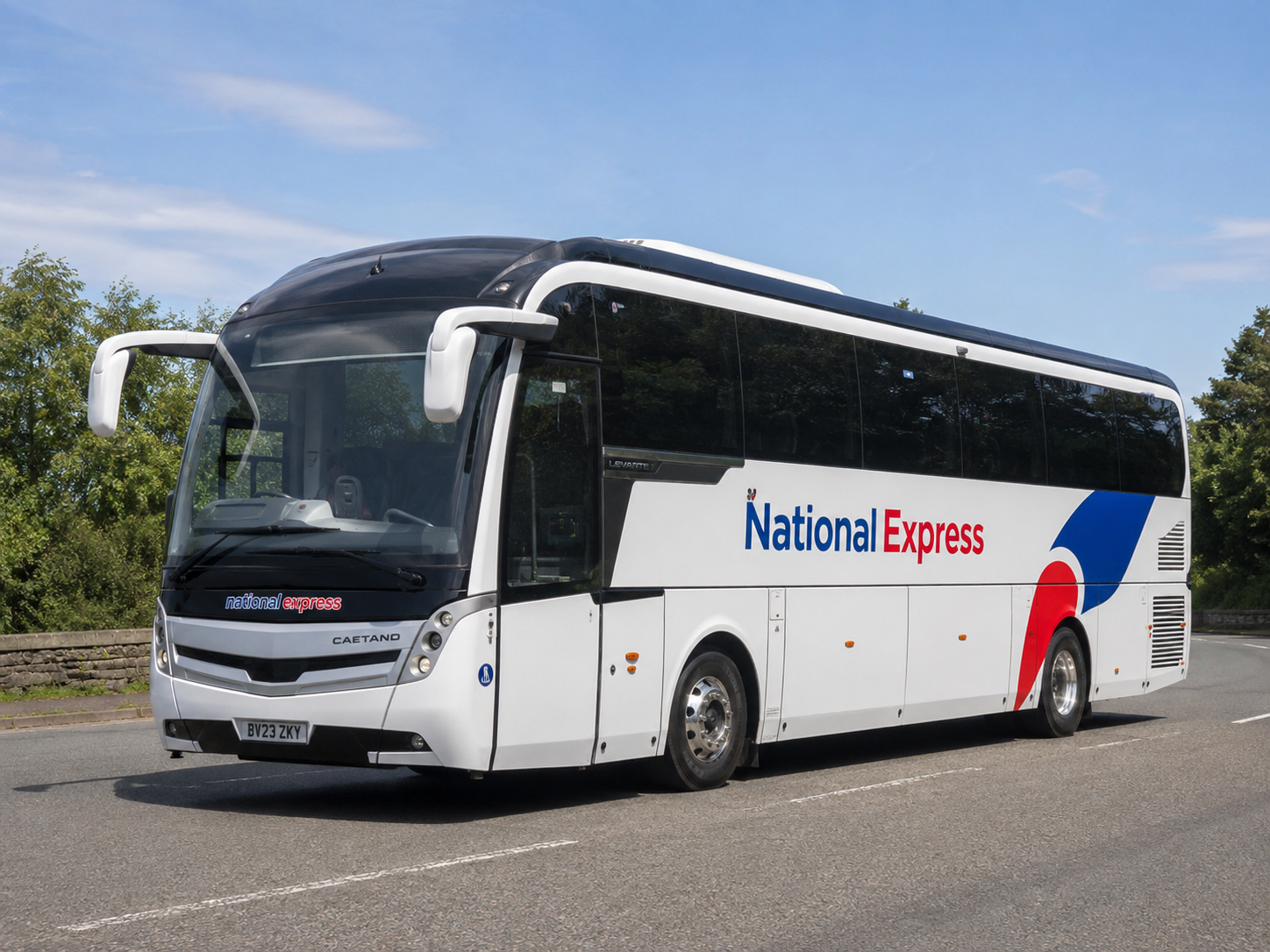
Coach travel can be a useful lower-cost option for a longer stay when you are happy to base yourself in one place.
For a one-day trip involving several small villages, the limited flexibility once you arrive is the greater consideration.
Is the Cotswolds a realistic day trip from London?
Yes, but only if you accept that you will see one small part of the Cotswolds rather than "the Cotswolds" as a whole.
The region covers around 790 square miles. Trying to combine widely separated northern, central and southern locations in one day can turn a countryside visit into a series of journeys between car parks.
For a day trip, a better approach is to:
- choose one part of the region
- select one main town or village
- add one or two genuinely nearby places if time allows
- check the return journey before setting out
- avoid choosing destinations purely because they appear on the same "best Cotswolds villages" list

By train, the simplest day trips are those built around a useful rail gateway or a carefully checked onward connection.
By car, you have more freedom, but that does not make it sensible to cross the whole region.
An organised day tour can make sense for visitors who want to see several well-known villages without driving or coordinating rural public transport. The trade-off is that the itinerary and time spent in each place are fixed.

Train or car: which is better from London?
There is no universal answer.
Choose the train if:
- you do not want to drive in London
- you are visiting one accessible area
- you are staying overnight and can arrange onward transport
- Moreton-in-Marsh or another rail-connected location is your main destination
Choose a car if:
- you want to visit several rural villages
- your destinations are poorly connected to each other
- you are travelling with luggage or equipment
- flexibility matters more than avoiding the drive
Consider a tour if:
- you only have one day
- you want to see several well-known locations
- you do not want to research rural bus and taxi connections
The mistake is assuming that because the train journey from London can be relatively quick, every Cotswold village becomes easy to reach.
It does not.
The most useful way to plan London to the Cotswolds
Start with the place, not the transport.
- Decide which part of the Cotswolds you want to visit.
- Choose the specific towns, villages or attractions.
- Check whether any have a railway station.
- Identify the nearest useful rail gateway if they do not.
- Check the entire onward journey, not just the train from Paddington.
- Compare that with the practical cost and convenience of driving.

A 70-minute train followed by an awkward rural connection may not be quicker than a longer direct journey. Equally, driving through central London simply to reach one rail-connected Cotswold town may add unnecessary stress.
The best route is the one that works for your actual destination.
Frequently asked questions
How far are the Cotswolds from London?
Many popular Cotswold destinations are roughly 75–100 miles from central London, but there is no single distance because the region stretches for around 90 miles from north to south.
How long does it take to get from London to the Cotswolds?
The fastest direct trains can reach Kemble from London Paddington in around 1 hour 6 minutes and Moreton-in-Marsh in around 1 hour 24 minutes. Driving time depends significantly on your destination and London traffic, so around two hours or more is a more realistic planning assumption for many road journeys.
Can you take a train from London to the Cotswolds?
Yes. Direct GWR services from London Paddington serve stations in and around different parts of the Cotswolds, including Moreton-in-Marsh and Kemble.
Which station in London goes to the Cotswolds?
London Paddington is the principal London station for direct GWR services towards the Cotswolds. The correct destination station depends on which part of the region you want to visit.
Can you visit the Cotswolds from London without a car?
Yes, but choose your destinations carefully. Rail services reach several useful gateways, while buses, taxis and tours provide some onward connections. Smaller rural villages generally require more planning than rail-connected towns.
Is a Cotswolds day trip from London worth doing?
A day trip can work well if you concentrate on one part of the region. Trying to visit widely separated villages in the northern, central and southern Cotswolds in a single day is likely to leave too much of the trip spent travelling.
Sources and editorial method
Travel routes and station information were checked against Great Western Railway, National Rail, National Express and current regional tourism information. Example rail journey times were checked in July 2026 and should be treated as indicative rather than permanent timetable guarantees.
Visit Cotswolds is an independent guide. The advice on choosing one compact area for a day trip is an editorial recommendation based on the geographical size of the region and the practical difference between reaching a railway gateway and travelling onwards into rural villages.
For live travel, always check your exact route and date with the relevant transport operator before setting out.
Last fact-checked: July 2026